View
Drag






If you're still running your website based on SEO advice from 2022, we should probably have a conversation. Google has overhauled how it ranks websites more aggressively in the last 18 months than at any point in recent history. The internet is still packed with outdated playbooks telling you to "just blog consistently" and "focus on keywords."
That's not going to cut it anymore.
Let's get into what Google actually cares about right now, what it means for your business and (most importantly) what you should be doing differently.
In 2022, Google launched the Helpful Content Update. The goal was to push down websites that were obviously writing for search engines instead of people. You know the type: those blog posts that technically contain an answer to your question but somehow make you feel dumber for reading them.
Originally, this ran as a separate system. A side filter, basically. But in March 2024, Google folded the entire thing into its core ranking algorithm. That's a big deal and most people missed it.
What it means: Google is no longer running a separate "is this helpful?" check. That evaluation is now baked into every ranking decision the algorithm makes. There's no version of your site that passes the "real" algorithm but gets dinged by the helpful content filter. It's all one thing now.
And the results speak for themselves. Google's core systems cut low-quality content from search results by 45%.
For business owners, the takeaway is pretty straightforward. You can't afford dead weight on your site anymore. Those blog posts you published in 2021 because someone said you should "post twice a month"? If they're generic, they're not just sitting there being harmless. They're actively pulling your site's performance down. Google is looking at your domain as a whole, and weak pages lower the grade for everyone
E-E-A-T stands for Experience, Expertise, Authoritativeness and Trustworthiness. It's the framework Google's quality raters use to evaluate whether the people behind a website are reliable. For years, this mostly applied to high-stakes topics like medical advice, financial planning and legal guidance. But after Google’s December 2025 core update, those credibility standards expanded across the board. If you’re selling products online, offering consulting services or publishing how-to content, Google is now evaluating your authority just as closely as it would a hospital’s health blog for "symptoms of a heart attack."
So what does Google actually want to see?
A real About page (not a paragraph you wrote in 10 minutes). Author bios with actual credentials on your blog posts. Consistent brand mentions across reputable third-party sources. Easy-to-find contact information and business details.
The most important piece of the whole framework is Trust. Everything else (Experience, Expertise, Authoritativeness) feeds into it. If someone lands on your site and can't quickly figure out who's behind it or why they should believe you, Google already knows that. And your rankings reflect it.
If your website design buries your About page or doesn't feature author bios at all, you're basically telling Google "don't worry about who we are."
This is the topic that's been dominating every SEO conversation lately, and for good reason. Google's AI Overviews (those AI-generated summaries that pop up above the regular search results) now reach 1.5 billion users monthly and appear on about 30% of desktop searches in the U.S.
When they show up, the top organic result loses roughly 34.5% of its clicks. For some B2B tech companies, traffic has dropped as much as 70%.
But what a lot of people are getting wrong about this: AI Overviews aren't bad for everyone. Sites that get cited inside an AI Overview are seeing click-through rates jump by up to 35%. In some cases, being referenced in an AI Overview is actually more valuable than holding the traditional #1 spot.
The difference comes down to what kind of content you're creating.
If your page answers a straightforward factual question (something like "what's a canonical tag?"), AI Overviews will summarize it and users won't need to click through. You become the source material for a box that replaces you. But if your content includes original analysis, a distinct perspective or real expertise that can't be easily distilled into a paragraph, Google's AI is more likely to cite you and send people your way.
The game has shifted. It's no longer just about ranking. It's about whether your content is the kind that gets sourced or the kind that gets swallowed.
This is worth its own section because this is where we see the most businesses lacking.
Google has gotten dramatically better at telling the difference between content that actually helps someone and content that just... exists. A lot of companies are sitting on blog archives full of posts that were perfectly acceptable two or three years ago and are now working against their search performance.
You probably know this type of content when you see it. Blog posts that skim the surface of a topic without offering anything you can't find in five other places. Pages built around a keyword that don't actually help anyone do anything. Content that exists because someone's marketing plan said "we need a blog" rather than because anyone had something worth saying.
Google's algorithm can now reliably detect the difference between those two motivations. It's the direct result of folding the helpful content signals into the core system. And it means content that was once "fine" is now a liability.
If a page on your site doesn't help someone accomplish something, make a better decision or understand something they didn't before, it's working against you. There's no neutral ground anymore.
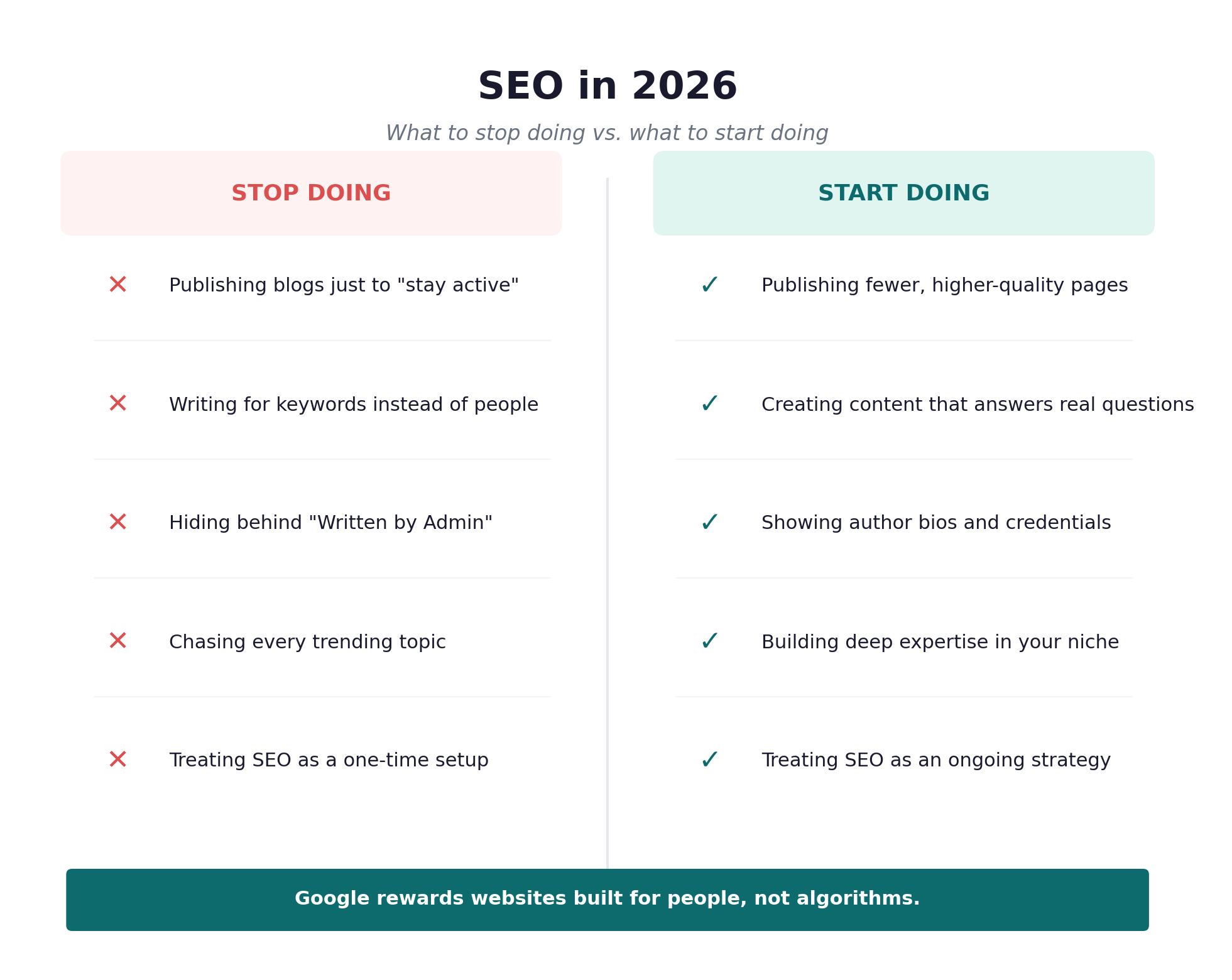
Audit your content. Be honest about what's working. Pull up your blog and go page by page. If a post is outdated or exists purely because you wanted to target a keyword, either rewrite it with real substance or take it down. A site with 20 genuinely valuable pages will outrank a site with 100 mediocre ones. That's not a theory. That's how Google's systems work now.
Go deep on topics instead of going wide on keywords. Google rewards topical authority, which means demonstrating deep expertise in your specific area. If you're a digital agency writing one blog about website design, another about cryptocurrency and another about meal prep, you're not building authority. You're confusing Google about what you actually know. Pick your lanes.
Write to be cited, not just to rank. With AI Overviews pulling content from the web and synthesizing it, your best bet is to create pages that include original insights, specific data or a strong point of view. Content that just restates what everyone else has already published won't get cited. It'll get absorbed.
Don't ignore the technical stuff. Core Web Vitals aren't the main ranking factor, but they're a tiebreaker. Google tracks how fast your largest content element loads (shoot for under 2.5 seconds), how responsive your site is when someone clicks something (under 200 milliseconds) and whether your layout shifts around while loading. If your content is equally as good as a competitor's but your site is slow and glitchy, they win.
Make your credibility impossible to miss. Beef up your About page. Put real bios on your blog posts. Make your contact info obvious. These are the signals Google is using to assess E-E-A-T, and they're simple to fix.
Think about SEO as an ongoing investment, not a one-time project. Every change Google has made points in the same direction: they want websites built for people. That means your SEO strategy needs to be baked into how you build and maintain your online presence, not something you sprinkle on after the fact.
Google in 2026 is actually doing what it always said it would do: reward the websites that are the most useful and trustworthy for any given search. The difference is that now it's actually good at it.
The businesses that show up in search results this year will be the ones that stopped treating their website like a chore and started treating it like their best employee. Fewer throwaway blog posts. More transparency about who you are. Content that actually earns its place on the internet by helping someone do something.
That's what Google wants. And honestly? It's not a bad thing.
E-E-A-T stands for Experience, Expertise, Authoritativeness and Trustworthiness. It's the framework Google uses to evaluate whether your website (and the people behind it) are credible.
AI Overviews are AI-generated summaries that appear at the top of certain Google search results. They pull information from existing web pages and present a synthesized answer directly in the search results.
Not necessarily. Sites that don't get cited in AI Overviews can lose up to 34.5% of their organic clicks. But sites that do get cited are seeing click-through rates increase by up to 35%. The key is creating content with original insights and a clear point of view rather than surface-level answers that AI can easily summarize without linking back to you.
If they're thin, outdated or clearly written just to target a keyword, yes. Google now evaluates your domain as a whole, and weak pages can drag down the performance of your stronger ones. A smaller site with high-quality content will outperform a bloated site with mediocre posts.
SEO is never an overnight thing. Most sites start seeing measurable movement within 3 to 6 months of making meaningful improvements to content quality and E-E-A-T signals. Technical fixes like Core Web Vitals can show results faster, sometimes within a few weeks of implementation.
Audit your existing content. Go through your blog and landing pages, identify anything that's outdated or generic and either rewrite it with real substance or remove it entirely. This one step cleans up your domain's overall quality signal and gives your best pages room to perform.
Boost your online visibility and drive organic traffic with our expert SEO services, making your business the top choice for customers.

Boost your online visibility and drive organic traffic with our expert SEO services, making your business the top choice for customers.