View
Drag






2025 was a strange year for marketing. On paper, we knew the economy promised more cautious buyers, higher ad costs and a social media landscape that reinvented itself every month.
But here's the quiet truth no one likes to admit: most campaigns didn't fail because the budget was too small. They failed because businesses were asking a 2020 strategy to perform in a 2025 world.
If your campaigns fell flat, your leads dried up, or you kept refreshing your analytics hoping the numbers would magically behave, you're not alone. The good news? The "why" behind the drop-off is more fixable than you think.
Before you torch your entire marketing plan, let's break down what truly changed and what still works if you use it correctly.
Despite the drama, 2025 wasn't the year marketing "broke." It was the year subtle changes stacked up until even well-intentioned strategies couldn't keep their footing.
Here's what actually happened and the consequence of not adapting:
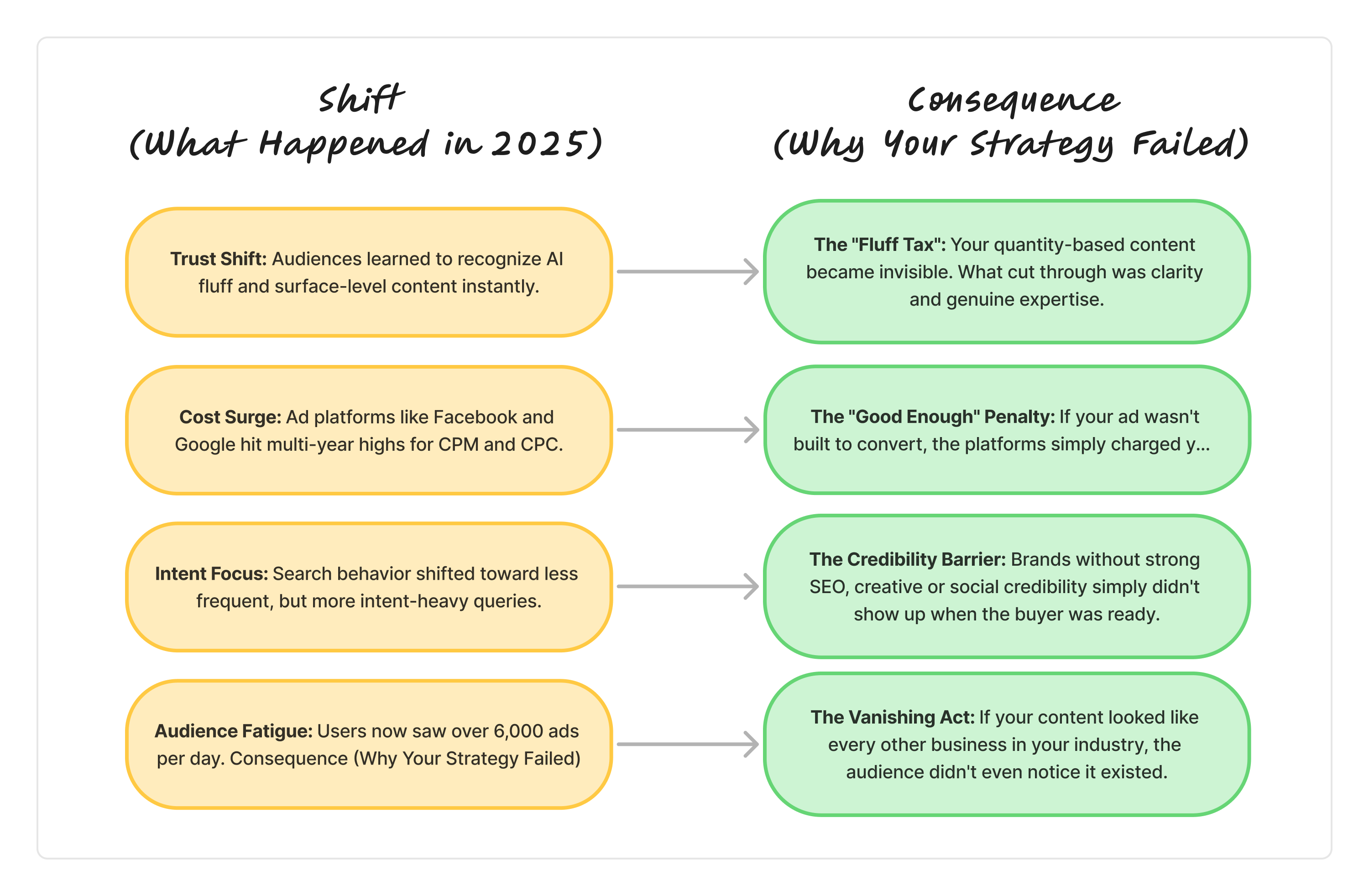
So no, it wasn't "just the budget." It was the difference between rising standards and stagnant strategy.
There are four main friction points we kept seeing, and almost every struggling business suffers from at least two of these.
Content wasn't the problem; directionless content was. 2025 rewarded specificity, depth, and utility, not volume. If you spent the year posting generic educational posts, inspirational quotes or once-a-month blogs, you were invisible.
This was the big one. People's habits changed. Their platforms changed. Their buying triggers changed. Your targeting stayed the same. The result? You paid for impressions that your audience no longer cared about.
In 2025, people didn't remember the businesses with the best ad spend; they remembered the businesses with the sharpest message. Content was the differentiator and the conversion engine. For many brands, the creative simply failed to evolve.
Traffic is only half the job. Most businesses had one or more critical gaps:
No landing pages built for conversion.
Traffic going straight to the generic homepage.
No retargeting layer.
No clear, defined offer (this one hurt the most).
If the landing experience didn't do its part, your ads never stood a chance.
None of these fixes require massive budgets; they require clarity, consistency and a conversion-focused approach.
Here's where brands that thrived in 2025 made their moves:
They Doubled Down on Intent-First SEO: Not keyword stuffing, actual intent mapping. This is the conversion-focused SEO approach we use inside our marketing services.
They Rebuilt Content with Sharper Messaging: Not more ads. Better ads. They used strong hooks, defined points of view and visuals that stood out, delivering offers people could say "yes" to in under eight seconds.
They Refined Their Funnels: Traffic shouldn't be expensive when your conversion path is tight. Brands that cleaned up their funnels, even lightly, saw meaningful lifts in ROAS, lead quality and retention.
They Got Honest About Their Targeting: Not everyone is your audience. Not every audience is ready to buy. The businesses that accepted this stopped bleeding ad spend.
If 2025 felt like pushing a boulder uphill, 2026 doesn't have to repeat the pattern. Here's your starting line, simple, grounded and guaranteed to give you clarity:
Audit Your Targeting: Who you reached in 2023–2024 is not who you're reaching now. Update it.
Fix Your Landing Experience: Homepages don't convert. Offers do.
Rebuild Your Creative Direction: If your ads and content are interchangeable with your competitors, your audience doesn't see you.
Invest in Strategy, Not Random Tactics: A well-structured SEO, PPC and social foundation beats "trying things" every time.
Commit to Consistency: Not more. Just better, consistently.
You have the roadmap. Now you need a specialist to execute it. At Hierographx, we don't just refresh your campaigns; we rebuild your entire conversion ecosystem. We apply a performance-focused framework and sharpen your content so your marketing budget stops burning cash and starts delivering guaranteed growth.
Transform your brand visibility and skyrocket sales with our holistic marketing strategies designed for your unique business needs.

Transform your brand visibility and skyrocket sales with our holistic marketing strategies designed for your unique business needs.