View
Drag






We work with Michigan small business owners almost every day, and the ones who haven't started automating anything usually already know they should. They'll describe their week and somewhere in there is a version of the same story: manually sending appointment reminders, chasing unpaid invoices one by one, copying form submissions into spreadsheets because their tools don't talk to each other. They know the time is being wasted. They just haven't had a clear starting point.
AI business automation has gotten to a place where the setup is genuinely straightforward, the tools are affordable and the results show up fast. The catch is knowing where to start and what to skip, because getting that order wrong is exactly why so many businesses tried this once and gave up on it.
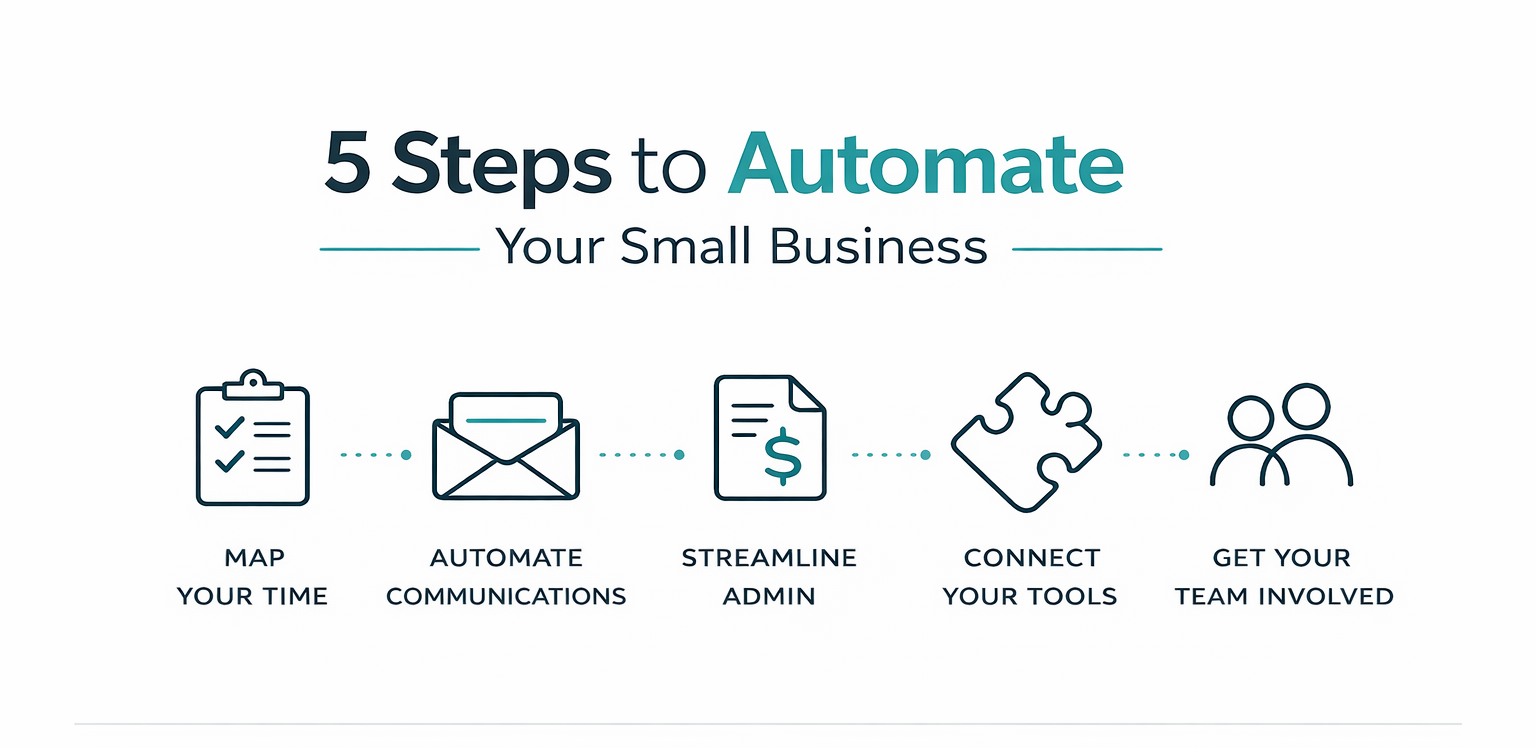
The first thing we ask any business owner considering automation is: what do you keep doing over and over that follows the same pattern every time? Not the big creative work or the client relationships. The administrative stuff. The tasks that run on the same track every week and could easily be handed off to a system if you sat down and mapped them out.
Here's what comes up most:
Appointment confirmations and reminders
Invoice follow-ups and payment chasing
Welcome emails for new clients
Social media scheduling
Copying data between platforms (form submissions into a CRM, for instance)
Reports you rebuild from scratch each week
We've watched a lot of businesses try automation, feel underwhelmed and write the whole thing off. Almost every single time, they started with the wrong task. They automated something that felt productive but didn't save them hours, saw no meaningful change and concluded it wasn't worth the effort. The best place to start is wherever the most time is going toward work that doesn't require any real judgment or decision-making. If a task takes 15 minutes and happens more than four times a week, it probably shouldn't involve a person.
A lot of business owners we talk to worry that automated messages will come across as impersonal. We get the hesitation, but in practice, the opposite usually happens. You write the message once, in your own voice, and the system sends it when it should go out. Your customer gets a professional, well-timed follow-up. You get your afternoon back.
The touchpoints that benefit most from AI business automation are the ones most likely to slip when you're busy: appointment reminders, follow-ups after a service is completed, re-engagement emails for customers who haven't come back in a while and review requests timed a couple of days after a job finishes. These are all messages your customers appreciate receiving, and they're the exact ones that tend to slip through the cracks.
Mailchimp, ActiveCampaign and HubSpot all handle this well, and none of them need a technical background to get running.
Once your customer communications are taken care of, the admin work is usually the next biggest opportunity.
Invoicing, payment follow-ups and client onboarding paperwork are where we see the most return for the least effort. QuickBooks, FreshBooks and HoneyBook can handle the cycle of sending invoices, following up on overdue ones and tracking payment status on their own. You set the rules once. If you're currently spending part of your week chasing payments, this will probably be the most satisfying automation you set up.
We hear the cost concern a lot. In practice, most of what a small business needs runs between $15 and $75 a month. These platforms also assume there's no IT team on the other end, so setup tends to take a few hours rather than a few weeks.
If you've tried automation before and walked away frustrated, there's a good chance this step is where things fell apart. The usual story: someone tried to wire up multiple platforms at the same time, something broke, data got duplicated or ended up in the wrong place and the whole effort got scrapped.
The scope was almost always the real issue. Connecting everything at once, before any single piece is tested and working, tends to produce a system nobody trusts. We always recommend starting with a single connection between two tools you already use. A few examples:
A contact form submission comes in on your website, and it auto-adds to your CRM
An invoice gets marked as paid, and your tracking sheet updates on its own
A client books an appointment, and they get a confirmation text
Zapier and Make both handle these connections and the setup is genuinely easy: when X happens, do Y. No code involved. Once that first connection is solid and you trust it, you add another one. Building piece by piece is how businesses end up with something they actually rely on rather than something that looked promising for a few weeks and then got abandoned.

If you have employees, the tools you pick are only part of what makes automation stick. When team members don't understand or trust a new system, they find ways to work around it, and that usually creates more problems than the original workflow had.
The owner gets excited about automation, builds it out, introduces it to the team and the team pushes back. It makes sense. They weren't involved in the decision. It feels like something done to them, not for them
When you're identifying which tasks waste the most time, ask the people who are actually doing those tasks every day. They know what's pointless. When they're part of surfacing the problem, they tend to be genuinely interested in whatever solution comes out of it.
Be upfront about the purpose, too. Automation is about getting rid of the work nobody enjoys doing, not about monitoring output or replacing roles.
Customer expectations in 2026 have been shaped by companies with entire teams dedicated to communication, follow-through and responsiveness. That's the bar small business owners are measured against, usually with a fraction of the staff and budget. Most already feel that gap. They just haven't found a practical way to close it.
AI business automation is one of the most straightforward paths to closing that gap without hiring for every piece of the puzzle.
Having the right AI automation company in your corner for that first setup makes a real difference. Not because the tools are complicated, but because picking the right starting point and dodging the common mistakes saves you the frustrating cycle of trying something, watching it break and shelving the idea for another year.
At Hierographx, that's what we do. If you're trying to figure out where to start, or you've been through a rough first attempt, we'd genuinely love to talk it through.
Genuinely, yes. Most of what you need runs well under $100 a month and a lot of the main platforms have free tiers that cover basic workflows. The better question is what the manual version of those tasks is costing you. Recovering even five hours a week adds up to over 250 hours across a year. Most businesses feel the difference within the first month.
Nine times out of ten, the scope was too big at the start or the wrong tool was picked for the job. Trying to automate a bunch of things at once before any single workflow is running reliably is the most common path to giving up on the whole idea. Starting with one focused process, proving it works and then building from there is a completely different experience. Having an experienced AI automation company guiding the first setup skips most of the trial and error.
Nope. These platforms are designed for business owners, not developers. If you can use email and a spreadsheet, you can handle most of them. Some initial setup guidance from a knowledgeable partner helps, but the day-to-day management is genuinely minimal once things are running.
Only if you set it up that way. You write every message and set the tone. Automation just handles when it goes out. A thoughtful automated follow-up that arrives right on time is a better experience for your customer than a personal one you meant to send but didn't get to. Consistency is what people actually remember about working with a business.
Whatever is eating up the most repeated time in your week. For most small businesses that's either customer follow-up communications or invoicing and payment tracking. Both are fast to set up, the results are obvious and they free up real time quickly. Start with one, get it stable and expand from there.
Supercharge your online presence with our cutting-edge development services tailored for your business growth.

Supercharge your online presence with our cutting-edge development services tailored for your business growth.